




Paxson Question of the Month (Vol. 8: New Employee Training Protocols)
Each month, we feature a real question asked by one of your fellow ICS members through Paxson, our closed-system AI assistant built just for Illinois chiropractic physicians. Paxson provides quick, accurate, and member-directed support on a wide range of topics—from insurance issues and licensure requirements to documentation, compliance to social media posts, and more.
These featured questions offer valuable insights you can use in your own practice—and serve as a reminder that help is just a click away.
Advertisement
Have a question? Paxson is ready when you are at www.ilchiro.org/paxson.
Important Note: The ICS strongly encourages our doctors to provide more detail when asking their initial questions. Although Paxson will make an effort to understand context, we believe the results it provides will be much closer to your needs when members provide longer questions/prompts that give greater context.
New Employee Training Protocols
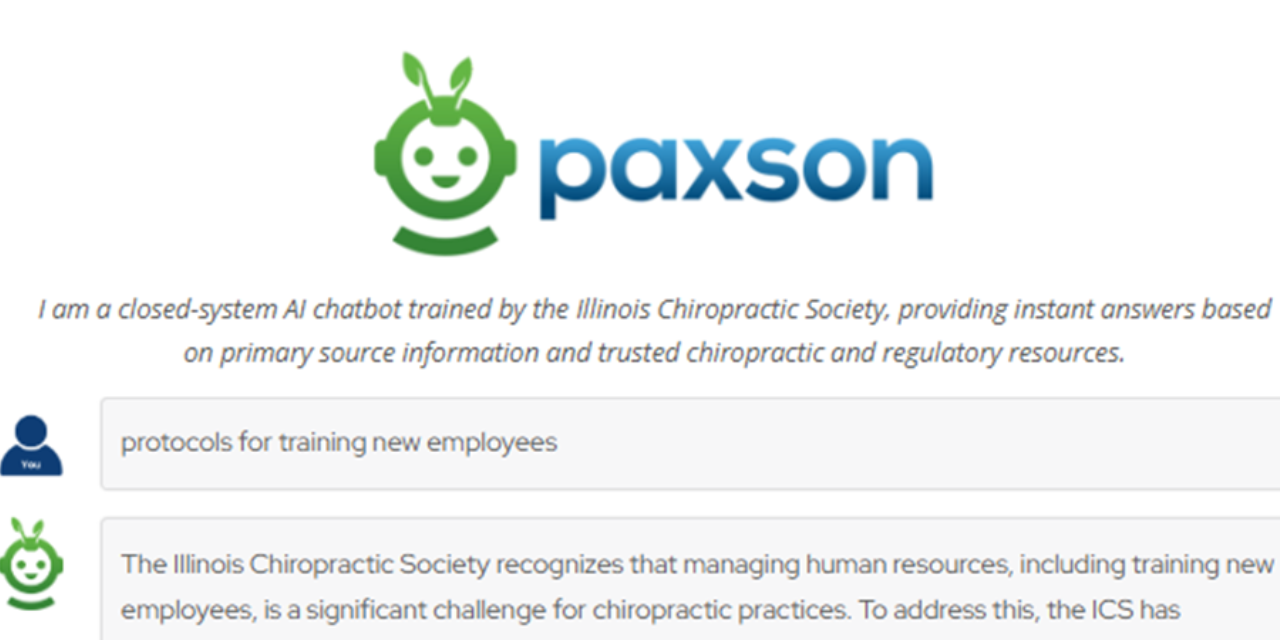
ICS Member Question:
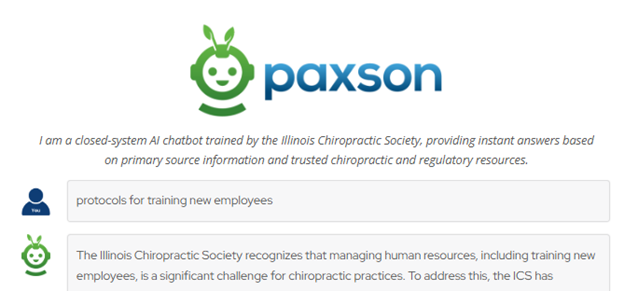
“protocols for training new employees”
Paxson’s Response:
For chiropractic practices, establishing clear protocols for training new employees is essential for compliance, efficiency, and maintaining high standards of patient care. Here are key elements and recommended steps for a new employee training protocol based on current best practices:
1. Timing of Training
– All required training should be completed within the first month after hiring.
2. Core Training Topics
– Code of Conduct: Train all employees and contractors on expected conduct and ethical behavior.
– Compliance Plan: Educate staff on the compliance plan, their roles, and responsibilities in promoting adherence to laws, regulations, and guidelines. Topics may include:
- Federal False Claims Act
- Anti-kickback statute
- Physician Self-referral Law (Stark)
- State fraud and abuse laws
- Identity and role of the Compliance Officer
- Open communication and nonretaliation policies
– HIPAA Privacy and Security: All staff must be trained on HIPAA rules and their responsibilities in protecting patient privacy and security. This should occur soon after hire and at least annually thereafter.
– Billing and Coding: Employees involved in billing and coding must receive role-specific training on accurate and compliant practices.
– Conflict of Interest: All staff should be trained on conflict of interest policies and procedures.
3. Documentation and Tracking
– Maintain a training log that includes:
- Name of employee
- Date of training
- Topic covered
4. Communication and Reporting
– Inform employees about the “open door” policy for reporting concerns.
– Provide clear reporting methods (e.g., Compliance Officer, Human Resources, Clinic Owner, anonymous reporting).
5. Ongoing Education
– Incorporate compliance updates and changes into regular meetings, video clips, or company-wide communications.
– Require annual participation in compliance training as a condition of employment and performance evaluation.
6. Enforcement and Remediation
– Participation in training is mandatory. Failure to comply may result in corrective action or termination.
– Offer remediation attempts at the discretion of leadership.
7. Investigation and Corrective Action
– Establish a process for investigating potential compliance issues, including logging reports, reviewing findings, and taking corrective action as needed.
8. Incentives for Compliance
– Recognize and reward excellent compliance performance or significant contributions to the compliance program.
Would you like a step-by-step checklist or a customizable template for your new employee training protocol that you can adapt for your practice?
[Editor’s Note: Paxson will always follow-up answers by asking for the next logical task you may need. You can simply type “yes,” and Paxson will provide the indicated information, template, or protocol. However, you can also type “yes AND…” followed by additional context. In this instance, for example, the member could have followed-up with “yes, and provide an additional checklist that we should be using for ongoing annual training for our existing employees. Also, tailor the templates for my practice – my name is Dr. Pat Smith and my practice name is Enabled Back and Neck.”]